In 2010, I posted on this site about the 1945 Kansas City Monarchs season in "real time," meaning that I'd write up a game that happened on August 28, 1945 on August 28, 2010. The posts show up in reverse order, so if you'd like to follow the season from the beginning, here is a link to the first post. You can also find posts by browsing the archive and/or tags list in the right column.

Wednesday, February 12, 3000

Thursday, April 14, 2016
"What's Wrong With Negro Baseball?" by Jackie Robinson Provides Insights
 |
| The Ebony issue carried this image, which is the best version of the picture I've seen. Any eagle-eyed ballpark experts able to identify the park? That's a road uniform, so it's probably not in KC. |
 I am thrilled to have finally found articles penned by Jackie Robinson from the June, 1948 Ebony magazine. I've known that they existed for quite some time, but the full text has been surprisingly difficult for me to locate. It contains a treasure trove of information regarding Jackie's time with the Monarchs and his opinion of the Negro leagues in general.
The cover of the issue featured a close-up of Jackie's face with the provocative headline "What's Wrong With Negro Baseball?" In the article under the same title, Jackie excoriates the Negro leagues for a lack of official contracts, low salaries, sloppy umpiring, questionable business connections of owners, a lack of practice before starting spring training games, uncomfortable buses, cheap hotels in disrepair, lack of rules controlling player behavior, and player expenses not being covered by clubs. Quite the list.
Jackie had a passionate moral certitude that perhaps was a necessary component of his incredible strength in his fruitful fights for integration and equality. His fiery hatred of segregation is understandable and natural, but what is less clear to me is why, when it came to baseball, he directed that hatred toward the institutions that were the victims of segregation and oppression instead of the perpetrators. He claims in this article that he knows "Negro club owners cannot afford to be as generous as the big leagues," but the rest of the article clearly demonstrates he did not have a full appreciation of that fact, and, more importantly, why the Negro leagues couldn't afford to spend like the white major leagues or who was at fault for that disparity.
He laments the lack of a formal contract with the Monarchs, which made him worry about his ability to collect the full salary promised him. He also points out, "from the club's point of view, I felt that I could in no way be held liable to the Monarchs and could leave at any time I wanted to go." In all my reading on the Monarchs, I've seen exactly zero charges of players being underpaid by owners J.L. Wilkinson or Tom Baird. I'm sure Jackie would have included it in this article if he was ever short-changed. While I agree with Jackie that it would have been better business for the leagues to have used formal player contracts, Jackie seems to have lacked an awareness of which party the lack of a contract ended up harming in his case. His overall point that the Negro leagues could have increased their professionalism by signing formal player contracts is accurate, though they had been given no reason to think they were at risk of having their players poached by white baseball. It is my understanding that after Jackie joined the Dodgers organization, Negro leagues owners did make sure they had their ducks in a row regarding solid player contracts.
He also laments low salaries in the Negro leagues, though he himself had considered his $100/week salary in 1945 a "financial bonanza" compared to other opportunities available to him (according to his 1972 autobiography). Negro league salaries were indeed lower in comparison to the white majors, but by placing the blame for that on the Negro leagues, Jackie again shows a surprising lack of awareness.
The article clears up that there was some contact between Jackie and the Monarchs after he took off for Brooklyn to meet Rickey. I had felt pretty sure he had not returned to play the end of the season with the Monarchs, though I remember seeing one source suggesting he did which left some nagging doubt. It is clear now that he did not play any more games with the club after August, but, somewhat surprisingly, he did actually want to. The true nature of his trip to Brooklyn and agreement with Rickey was a closely guarded secret for two months, so what excuse he gave the Monarchs for his sudden absence, I don't know. But the Ebony article reveals:
In September 1945 I went to the management of the Kansas City club to get permission to play up until September 21 in exhibition games and then go home, as I was tired. I was told I would have to play all the games or none. I was left with no other alternative than to leave the ball club. The owner's son gave me a lecture and assured me that if I left the club I was through, that I could play no place outside of the Negro National League, and that he was sure that Kansas City was the only team with which I could play. The "cooperation" I received that afternoon made me glad I no longer had to play with the Kansas City ball club.
September 21 is a very specific date to remember as Jackie wrote this three years after the fact, but it does make sense with what I know about the Monarchs schedule in September of '45. The club was in Illinois, Ohio, Michigan, Indiana, Missouri, and Kansas through the 20th, then down to Oklahoma, Texas, and Louisiana for the rest of the month, so perhaps Jackie was willing to tour the Midwest in order to earn some money but couldn't stomach the idea of adding a Southern trip on top of that.
The same Ebony issue featured excerpts from Jackie's 1948 book My Own Story. It contains a wonderful telling of the Brooklyn Dodgers first contact with Jackie in August, 1945. A Monarchs player asked,
"Who's the white fellow you were talking to, Jackie?" "I don't know," I said. "He says he's scouting me for the Brooklyn Dodgers." Everyone on the bench laughed, including me. One of the players jumped up and saluted me. "I'm a scout, too," he said, standing very erect. "I'm from Moose Face Troop No. 60 and if I pass my Eagle test next week, I'm gonna fly away." We all got a great kick out of it. The possibility of a Big League scout spending his time looking at Negro players was nothing but a joke.The article also reveals that he later that same day expressed worry to the "white fellow," Clyde Sukeforth, about losing his job with the Monarchs if he takes off for Brooklyn to meet with Branch Rickey. Jackie remembered Sukeforth smiling and saying, "Don't worry about that. I think you've seen your last day with Kansas City." That doesn't gel with other impressions I've gotten that Sukeforth was not 100% certain of what Rickey's intentions were. I'd be surprised if Rickey himself was definite about signing Jackie before they discussed it face to face.
I'm pleased to host legible images of both articles in full below. These are important pieces that should be freely available to all. (If clicking on the images brings up a smallish slideshow, try then right clicking on the image in the slideshow and selecting "open image in new tab" or something similar in order to view at full-size.)
Tuesday, April 12, 2016
Article on Flatland
Kansas City Public Television's digital magazine Flatland has a piece about Jackie's 1945 season here. Jesse Howe created a nice info-graphic using data from this website, and included a Q&A with me at the bottom of the article. I'm posting the Q&A below.
Monday, August 26, 2013
"Jackie With the Monarchs" Presentation Video
Here is the presentation I gave at the Negro Leagues Baseball Museum on April 13, 2013.
Monday, April 15, 2013
"Jackie With The Monarchs" Speech

Thanks
to Dr. Doswell and Mr. Kendrick for inviting me to speak. I love this place,
and it’s a thrill to be here doing this.
Like a
lot of baseball fans, the history of the game is a big part of my appreciation
and fandom. And being born and raised here, the history of baseball in Kansas
City is especially compelling to me. So knowing that one of the most important
players in baseball history was playing for one of the hometown teams of the
past when he was signed to break the color line in the majors, I naturally wanted
to learn all I could about Jackie Robinson’s season playing for the Monarchs in
1945. It’s a part of his story that is often just brushed over. Jackie touches
on it briefly in his autobiography, and several other books have some good information,
but my curiosity still wasn’t satisfied after reading the more modern sources I
could find on the topic. My remaining curiosity led me to seek out contemporary
news accounts from 1945, and I started at the downtown Kansas City library
looking at microfilm from the Kansas City
Call, the newspaper geared toward the black community in Kansas City that
is still in operation just across the street. I started piecing together the
day-to-day happenings of the ’45 season. I added to what I found in the Call by searching various online
archives, and, along with some help from other researchers, I managed to get a
pretty good feel for the five months Jackie spent with the Monarchs. Negro
leagues coverage was spotty compared to the immaculate major league records we
are used to, but there is more information than you might think. There were
plenty of fascinating details to be found, and I hope you’re interested to hear
them.
Saturday, March 30, 2013
"Jackie With The Monarchs" Talk at Negro Leagues Museum April 13

There are several other Jackie Robinson Day-related events going on with the museum that you can find out about at their website and Facebook page.
I'm also excited about the Kansas City premiere of new Robinson bio-pic 42 on April 11. Word is few tickets remain, so get 'em while the gettin's good.
Thursday, November 10, 2011


Saturday, February 5, 2011
Jackie In 1942 KC Paper
I was researching the Monarchs 1942 season when I came across the below photo of Private Jackie Robinson serving at Fort Riley, Kansas. The photo ran three years before he became a Monarch, and is further evidence of the national notoriety he had gained as a multiple-sport star at UCLA.
 |
| May 1, 1942 Kansas City Call |
Wednesday, September 8, 2010
Can You Help?
The day-by-day tracking of the 1945 Kansas City Monarchs has come to a close, but that doesn't mean I'm not still on the lookout for game reports. I'll go back and add info and stats if and when they turn up. If you're interested in helping, here's a list of Monarchs games I have reason to think were played but for which I have no report. If you have access to newspaper archives for the host cities, perhaps you'd be good enough to check. Thanks!
April 9 vs. Birmingham Black Barons in Montgomery
April 10 vs. Birmingham Black Barons in Montgomery
April 13 vs. Memphis Red Sox in Little Rock
April 23 vs. Cincy-Indy Clowns in New Orleans
April 24 vs. Cincy-Indy Clowns in Houston
April 25 vs. Cincy-Indy Clowns in Houston
April 26 vs. Cincy-Indy Clowns in Houston
April 30 vs. Cincy-Indy Clowns in Houston
May 1 vs. Cincy-Indy Clowns in Waco
May 2 vs. Cincy-Indy Clowns in Ft. Worth
May 4 vs. Cincy-Indy Clowns in Oklahoma City
May 15 vs. Birmingham Black Barons in Oklahoma City
May 23 vs. Cincy-Indy Clowns in Indianapolis
June 4 vs. Birmingham Black Barons in Montgomery
June 5 vs. Birmingham Black Barons in New Orleans
June 7 vs. Birmingham Black Barons in Nashville
June 11 vs. Cincy-Indy Clowns in Kansas City
June 12 vs. Cincy-Indy Clowns in Belleville, IL
June 23 vs. Homestead Grays in ?
July 17 vs. Baltimore Elite Giants in Baltimore
July 30 vs. Chicago American Giants in Kansas City
August 11 vs. Baltimore Elite Giants in ?
August 11 vs. Birmingham Black Barons in Wilmington, DE
August 17 vs. Baltimore Elite Giants in Baltimore
August 21 vs. Cincy-Indy Clowns in Nashville
September 2 vs. Memphis Red Sox in Kansas City
September 3 vs. Memphis Red Sox in Kansas City
September 4 vs. Memphis Red Sox in Belleville, IL
September 7 vs. Birmingham Black Barons in Toledo
September 20 vs. Cincy-Indy Clowns in Wichita, KS
September 23 vs. Cincy-Indy Clowns in Houston
September 24 vs. Cincy-Indy Clowns in Houston
September 25 vs. Cincy-Indy Clowns in Waco
September 26 vs. Cincy-Indy Clowns in Ft. Worth
September 27 vs. Cincy-Indy Clowns in Dallas
September 28 vs. Cincy-Indy Clowns in Ft. Worth
April 9 vs. Birmingham Black Barons in Montgomery
April 10 vs. Birmingham Black Barons in Montgomery
April 13 vs. Memphis Red Sox in Little Rock
April 23 vs. Cincy-Indy Clowns in New Orleans
April 24 vs. Cincy-Indy Clowns in Houston
April 25 vs. Cincy-Indy Clowns in Houston
April 26 vs. Cincy-Indy Clowns in Houston
April 30 vs. Cincy-Indy Clowns in Houston
May 1 vs. Cincy-Indy Clowns in Waco
May 2 vs. Cincy-Indy Clowns in Ft. Worth
May 4 vs. Cincy-Indy Clowns in Oklahoma City
May 15 vs. Birmingham Black Barons in Oklahoma City
May 23 vs. Cincy-Indy Clowns in Indianapolis
June 4 vs. Birmingham Black Barons in Montgomery
June 5 vs. Birmingham Black Barons in New Orleans
June 7 vs. Birmingham Black Barons in Nashville
June 11 vs. Cincy-Indy Clowns in Kansas City
June 12 vs. Cincy-Indy Clowns in Belleville, IL
June 23 vs. Homestead Grays in ?
July 17 vs. Baltimore Elite Giants in Baltimore
July 30 vs. Chicago American Giants in Kansas City
August 11 vs. Baltimore Elite Giants in ?
August 11 vs. Birmingham Black Barons in Wilmington, DE
August 17 vs. Baltimore Elite Giants in Baltimore
August 21 vs. Cincy-Indy Clowns in Nashville
September 2 vs. Memphis Red Sox in Kansas City
September 3 vs. Memphis Red Sox in Kansas City
September 4 vs. Memphis Red Sox in Belleville, IL
September 7 vs. Birmingham Black Barons in Toledo
September 20 vs. Cincy-Indy Clowns in Wichita, KS
September 23 vs. Cincy-Indy Clowns in Houston
September 24 vs. Cincy-Indy Clowns in Houston
September 25 vs. Cincy-Indy Clowns in Waco
September 26 vs. Cincy-Indy Clowns in Ft. Worth
September 27 vs. Cincy-Indy Clowns in Dallas
September 28 vs. Cincy-Indy Clowns in Ft. Worth
Thank Yous
One of the fun things about this project has been receiving help from fellow Negro Leagues enthusiasts. I posted to the SABR email list before starting the project asking for help, and I am grateful to all those who have generously assisted me.
Thanks to:
Chris Wertz
Dwayne Isgrig
Larry Lester
Wayne Stivers
Howard Henry
John Erardi
Jeff Zimmerman and Royals Review for the interview
And special thanks to John Holway, who paid out of his own pocket for research to be conducted that turned up many game accounts I wouldn't have otherwise found.
Thanks to:
Chris Wertz
Dwayne Isgrig
Larry Lester
Wayne Stivers
Howard Henry
John Erardi
Jeff Zimmerman and Royals Review for the interview
And special thanks to John Holway, who paid out of his own pocket for research to be conducted that turned up many game accounts I wouldn't have otherwise found.
Sunday, September 5, 2010
Your 1945 Kansas City Monarchs

(click to enlarge)
front row, L to R: Frank Duncan, John Scott, Jackie Robinson, Chico Renfroe, Chester Gray, Herb Souell, Walter Thomas, Sammie Haynes
back row: Jesse Williams, Jack Matchett, Booker McDaniels, Jim "Lefty" LaMarque, Dozier Hood, Eddie Williams, Lee Moody, Hilton Smith, Ensloe Wylie
Photo is from the wonderful book Black Baseball in Kansas City, which is a collection of photos with a heavy emphasis on the Monarchs.
Jackie wrote in his autobiography that playing in the Negro Leagues was a miserable way to make a buck, but he always seems to have a beaming smile in the few pictures of him with the Monarchs!
Jackie wrote in his autobiography that playing in the Negro Leagues was a miserable way to make a buck, but he always seems to have a beaming smile in the few pictures of him with the Monarchs!
Saturday, September 4, 2010
Postseason Exhibitions End The Season
The regular season came to an end on September 3rd, and the Monarchs weren't headed for the playoffs - but they weren't quite done either. They played exhibitions throughout September, including a long series with the Clowns between the 15th and 30th. I've scraped together nine game results from this period that include five wins to four losses. On the 18th in KC, outfielder John Scott knocked two home runs in a 6-0 win, with Lefty LaMarque tossing the shutout. The next day, Scott hit a double and triple as the Monarchs trounced the Clowns 9-1. The season came to a close in New Orleans when the workhorse of the '45 pitching staff, Booker McDaniels, tossed a gem: 13 strikeouts, three hits and a shutout.

And here's a look at the approximately 3,500 miles added to the bus on the tour:
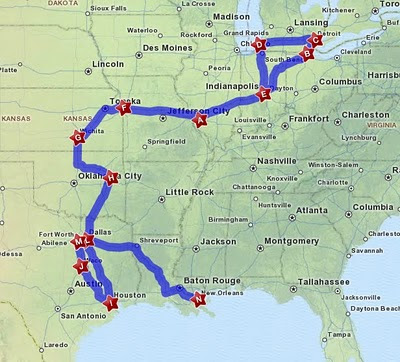
9/28 Kansas City Call re: 9/18 & 9/19:


Here's what the postseason exhibition schedule looked like:

And here's a look at the approximately 3,500 miles added to the bus on the tour:

9/28 Kansas City Call re: 9/18 & 9/19:
10/6 Pittsburgh Courier re: 9/30:
Friday, August 27, 2010
End Of The Second Half
The Monarchs played just a few more regular season games after Jackie was injured on August 21 and left the team for good on August 27. They lost their fourth straight game to the American Giants in Chicago on the 27th, 5-6. Rarely used Monarchs pitcher Steve Wylie walked in the winning run in the bottom of the ninth. On the 28th, while Jackie Robinson was meeting with Branch Rickey in Brooklyn, the Monarchs continued their losing ways by dropping both ends of a double header to the Clowns in Cincinnati. Hilton Smith pitched the first game, a 5-6 loss, while Lefty LaMarque pitched the second game, a 0-3 loss. In the final games of the regular season, the Monarchs hosted the Memphis Red Sox in double headers on September 2nd and 3rd. I unfortunately don't know the results of these games. Regardless, the Monarchs late season slide meant they no longer had any hope of capturing the second half title for the right to face the Cleveland Buckeyes in a postseason series to determine an American League champion. Games I've turned up show a 15-12 second half record, but final standings from the September 14 Call give their record as 8-8. If I remove games against the National League and non-league competition, I show a 7-10 record for the Monarchs. No hope for a postseason berth.
According to the September 14th Call, the AL batting leaders finished like this:
.393 Sam Jethroe, Cleveland
.372 Art Wilson, Birmingham
.361 Art Pennington, Chicago
.352 Ed Steele, Birmingham
Furthermore,


According to the September 14th Call, the AL batting leaders finished like this:
.393 Sam Jethroe, Cleveland
.372 Art Wilson, Birmingham
.361 Art Pennington, Chicago
.352 Ed Steele, Birmingham
Furthermore,
It was Jethroe almost "across the board" in the other departments too. The hard hitting Cleveland outfielder climaxed a great campaign by finishing on top in five other divisions with 55 runs scored, 123 total bases, 10 triples, 8 home runs and 21 stolen bases
The two Cleveland Jefferson boys, George and Willie, topped the pitchers. George was first with 11 victories and only 1 defeat and Willie second with a 10 mark. Gentry Jessup of Chicago, however, won the most games, 15, but lost 9.
The Monarchs won the team fielding honors, with .966...Jackie Robinson was seventh in individual batting standing, and LaMarque stood third in the number of games won.Here are the results I've found for the second half along with Jackie's hits and at-bats:

(click to enlarge)
And here's a look at the the 8,600 or so miles the team traveled in the second half. Lots of time in the northeast:

Thursday, August 26, 2010
Jackie's Time With The Monarchs Ends As He Heads To Brooklyn To Meet With Branch Rickey
The Monarchs were in Chicago for a four game set with the American Giants over August 24-27th. The Monarchs had a series to forget on the field, dropping all four contests while being outscored 29 to nine. Booker McDaniels had a particularly rough game on the 26th, allowing 15 runs and 21 hits in eight innings. The Monarchs managed no runs and just one hit in the game.

Off the field, however, it was a monumental series, even if no one knew it at the time. The Brooklyn Dodgers, in the person of scout/coach Clyde Sukeforth, made their first contact with Jackie at the game on Friday the 24th. According to Arnold Rampersad's Jackie Robinson: A Biography :
:
Robinson did go to the ballpark with his Monarchs teammates one last time on the 26th, but didn't play due to his injury. Chicago Defender sportswriter Fay Young had somehow gotten wind that Jackie might be heading east to meet with Rickey, and he questioned Jackie about it at Comiskey on the 26th. Young wrote in a September 1 column:


Jackie Robinson and Clyde Sukeforth (source)
Off the field, however, it was a monumental series, even if no one knew it at the time. The Brooklyn Dodgers, in the person of scout/coach Clyde Sukeforth, made their first contact with Jackie at the game on Friday the 24th. According to Arnold Rampersad's Jackie Robinson: A Biography
:On August 24, at Comiskey Park, Jack was out on the field, but nursing a sore shoulder, when a white man called out his name and beckoned. Jack went over. The man introduced himself as Clyde Sukeforth, which meant nothing to Robinson. The he said he was there on behalf of Branch Rickey of the Brooklyn Dodgers. Now he had Jack's attention. Mr. Rickey was starting a team, the Brooklyn Brown Dodgers. He wondered about Jackie's arm strength; could Jack throw a few balls for Sukeforth? The Dodger scout would remember Jack listening "carefully, and when I was through he spoke right up--Jackie was never shy, you know."
"Why is Mr. Rickey interested in my arm?" Jack asked. "Why is he interested in me?"
Sukeforth convinced Robinson to meet him after the game at the Stevens Hotel, where the scout was staying, and where he bribed a bellman two dollars to allow Jack to use the passenger elevator, from which blacks were normally barred. Eventually Jack arrived and began to pepper Sukeforth with questions. One thing above all intrigued both men. Mr. Rickey had made it clear, as Sukeforth informed Jack, that if Robinson would not come to him, he would come to Robinson. Both Jack and Sukeforth now suspected that something more than a place on the Brooklyn Brown Dodgers might be at stake.
The men arranged to meet in Toledo, where Sukeforth had to observe another player,then take the train to New York. Sukeforth then sent a wire to Rickey telling of Jack's injury ("Player fell on shoulder last Tuesday [21st]. Will be out of game a few more days"). On Sunday night [26th], after the white scout convinced a ticket seller that, yes, he intended to share quarters with the black man, they left Toledo.After a day of travel on the 27th, Robinson had his legendary meeting with Rickey on the 28th.
Robinson did go to the ballpark with his Monarchs teammates one last time on the 26th, but didn't play due to his injury. Chicago Defender sportswriter Fay Young had somehow gotten wind that Jackie might be heading east to meet with Rickey, and he questioned Jackie about it at Comiskey on the 26th. Young wrote in a September 1 column:
Between the doubleheader [on the 26th], your columnist flagged Robinson and asked him what there was to the rumors.
"Just rumors," answered Jackie.
Pressed for an answer to a simple question as to whether he had been invited, approached on the subject or not, Robinson evaded a direct answer.
Told that if it was such a secret , somebody had been doing some talking as too many, even to his club owner, knew about it, Robinson came back with a grin, "Well, it's a rumor. If you don't see me here tomorrow, then there's something to it."
September 1 Chicago Defender
Friday, August 20, 2010
Satchel Whiffs 15 Clowns In Complete Game Victory
From the August 21 Nashville Banner, courtesy of John Holway:
Leroy (Satchel) Paige showed Nashville baseball followers why he is regarded as one of the best hurlers in the country at Sulphur Dell Monday night as he turned back the Cincinnati Clowns, 6-4, for Kansas City on nine well-scattered safeties.
Paige, showing some of the best control seen at the Dell this year, threw a total of 133 pitches to the plate. 87 were strikes 25 were called balls and 21 were hit. He whiffed 15 opponents and walked but one man, a pinch hitter in the ninth.The Monarchs and Clowns played in Nashville again on the 21st before the Monarchs made their way to Chicago for a series against the Chicago American Giants that would prove fateful for Jackie Robinson.
Thursday, August 19, 2010
Sunday Double Header In Cincy
The Monarchs and Clowns played two on August 19 in Cincinnati's Crosley Field. The Clowns put "a serious crimp" in the Monarchs second half chances by sweeping the two games from KC.

August 25 Chicago Defender
Wednesday, August 18, 2010
Jackie On The End Of WWII And His Off-Season Plans
The US dropped atomic bombs on Japan on August 6th and 9th. By the 14th, Japan had informally surrendered. From the August 18 Afro-American:
The August 18 Pittsburgh Courier had this report on Jackie's off-season plans:
Jackie Robinson, former UCLA football star, now shortstop with the Kansas City Monarchs, and a veteran of 31 months: "I bet $5 it wouldn't be over before October, but that is one bet I am happy to lose. If it is true, it is great news. Now the boys can come home. My best friends and cousins are over there, so you know how I feel about the end."Monarchs in the service such as Buck O'Neil, Hank Thompson and Willard Brown could start dreaming about being back home and back with the Monarchs in '46.
The August 18 Pittsburgh Courier had this report on Jackie's off-season plans:
Sam Huston College of Austin, Texas, announced this week that Jack (The Rabbit) Robinson has signed a contract to coach football there this fall. Robinson, here last week playing shortstop for the Kansas City Monarchs, said he hasn't signed a contract and that he may play professional football in the Pacific Coast League.
3-1 Win Over Clowns In Indianapolis
Having wrapped up the last eastern swing of the season, the Monarchs headed back to the Midwest. The first stop was in Indianapolis on August 18. Hat tip to John Holway for turning up this brief game account from the August 19 Indianapolis Star:
The Kansas City Monarchs defeated the Indianapolis Clowns, 3 to 1, in a Negro American League game before approximately 3,000 fans at Victory Field last night.The line score reveals that Booker McDaniels was the lone Monarchs hurler.
Tuesday, August 17, 2010
Standings and Batting Leaders
The August 17th Kansas City Call published the below standings that show the Monarchs leading the way in the second half of the Negro American League season. The second half ran through September 3. The article lists the batting average leaders as of August 8 like so:
.429 G. Jefferson, Cleveland
.409 Sam Jethroe, Cleveland
.388 Ed Steele, Birmingham
.368 Art Pennington, Chicago
.360 Buddy Armour, Cleveland
.349 Jackie Robinson, Kansas City

Monday, August 16, 2010
3-3 Tie Versus The Grays In D.C.
After the Memphis Red Sox dispatched the Philadelphia Stars, the Monarchs and Homestead Grays faced off to round out a four team doubleheader at Washington, D.C.'s Griffith Stadium on August 16. Lefty LaMarque got the call to start for KC, and faced Roy Welmaker of the Grays. Josh Gibson was not in the Grays lineup this day, and LaMarque managed to take a 3-2 lead into the bottom of the ninth. But the Grays tied it up, prompting manager Frank Duncan to bring Hilton Smith in from the bullpen. After a scoreless tenth, the game was called "to allow the Monarchs to take a midnight train to Youngstown, Ohio" (August 25 Pittsburgh Courier).
This is the last game of Jackie's for which I have a box score. He went 1-for-3 with a double, bringing his average to .414 (41-for-99) in stats I've been able to uncover. That figure includes spring training, the all-star game, and barnstorming games outside of the Negro Leagues. In regular season games against Negro American and National League teams, I have Jackie hitting .436 (34-for-78). A hall of fame sanctioned study headed by Dick Clark and Larry Lester gives Jackie's average as .434 (23-for-53) and slugging as .660. Jackie probably played in over 100 games with the Monarchs, and the 99 at-bats I have for him come from just 26 games. All of these numbers are mere hints at how Jackie fared, but they leave the clear impression that he was a phenomenal player in 1945.
This is the last game of Jackie's for which I have a box score. He went 1-for-3 with a double, bringing his average to .414 (41-for-99) in stats I've been able to uncover. That figure includes spring training, the all-star game, and barnstorming games outside of the Negro Leagues. In regular season games against Negro American and National League teams, I have Jackie hitting .436 (34-for-78). A hall of fame sanctioned study headed by Dick Clark and Larry Lester gives Jackie's average as .434 (23-for-53) and slugging as .660. Jackie probably played in over 100 games with the Monarchs, and the 99 at-bats I have for him come from just 26 games. All of these numbers are mere hints at how Jackie fared, but they leave the clear impression that he was a phenomenal player in 1945.
Subscribe to:
Posts (Atom)